Vijayarajan & Associates - NRI Selling Property in India: Tax and TDS under the Income Tax Act, 2025
How an NRI is taxed on selling property in India — section 393(2) TDS, why indexation is unavailable, Forms 145 and 146, and the October 2026 TAN relief.
September 2026 — references are to the Income Tax Act, 2025 (in force from 1 April 2026) and the Income-tax Rules, 2026
In brief
- TDS on a sale by a non-resident is deducted under section 393(2), Table Sl. No. 17 of the Income Tax Act, 2025 — not section 393(1), which applies to resident sellers.
- The deduction is on the whole sale consideration, not on the capital gain.
- An NRI cannot claim indexation. The rate is 12.5 per cent without indexation, whatever the acquisition date.
- Two routes reduce the deduction: Form 128 (seller, section 395(1)) and Form 129 (buyer, section 395(2)).
- From 1 October 2026, a resident individual or HUF buyer is relieved of TAN under section 397(1)(c).
- Remittance uses Form 145. Form 146 is not required where an Assessing Officer's certificate has been obtained.
Anyone who has handled an NRI property sale under the old law needs to relearn the references. The Income Tax Act, 2025 replaced the Income Tax Act, 1961 with effect from 1 April 2026, and most of the sections and forms a buyer or seller will encounter have been renumbered. The substantive obligations have largely survived. The citations have not, and using the old ones now produces the wrong form and, occasionally, the wrong provision.
Two statutes govern the transaction at the same time. The Income Tax Act, 2025 determines the capital gains liability and the buyer's withholding obligation. The Foreign Exchange Management Act, 1999 governs whether, and how, the seller may remit the proceeds abroad.
Am I a non-resident under the Income Tax Act or under FEMA?
The two enactments use different tests, and the same person can fall on different sides of them in the same year.
FEMA looks at purpose and intention of stay. A person who has gone abroad for employment, business, or for an uncertain period is a person resident outside India, irrespective of the day count in a particular year.
The Income Tax Act looks at physical presence, and the test is not a single 182-day rule. An individual is ordinarily resident in India in a tax year if present for 182 days or more in that year, or present for 60 days or more in that year and 365 days or more across the four preceding years. Both limbs are subject to modification: special day-count thresholds apply to Indian citizens leaving India for employment and to Indian citizens and persons of Indian origin visiting India, and a separate deeming provision can treat certain Indian citizens with Indian-source income above ₹15 lakh as resident where they are not liable to tax in any other country. The correct position for a given seller turns on the facts of that year and the preceding four.
Residential status under the Income Tax Act determines which withholding machinery applies — the resident provisions or the non-resident provisions. It does not by itself fix the rate; that requires a separate determination, discussed below. Residential status under FEMA governs repatriation.
Because status materially affects the computation, the seller should establish the correct residential status for the relevant tax year before the agreement is finalised. Status follows from statutory facts; it is not something a seller elects.
Is the gain short-term or long-term?
For immovable property, the holding period threshold is 24 months. More than 24 months produces a long-term capital gain; 24 months or less produces a short-term capital gain. Where property has been inherited, the previous owner's holding period is included.
What rate applies, and can an NRI claim indexation?
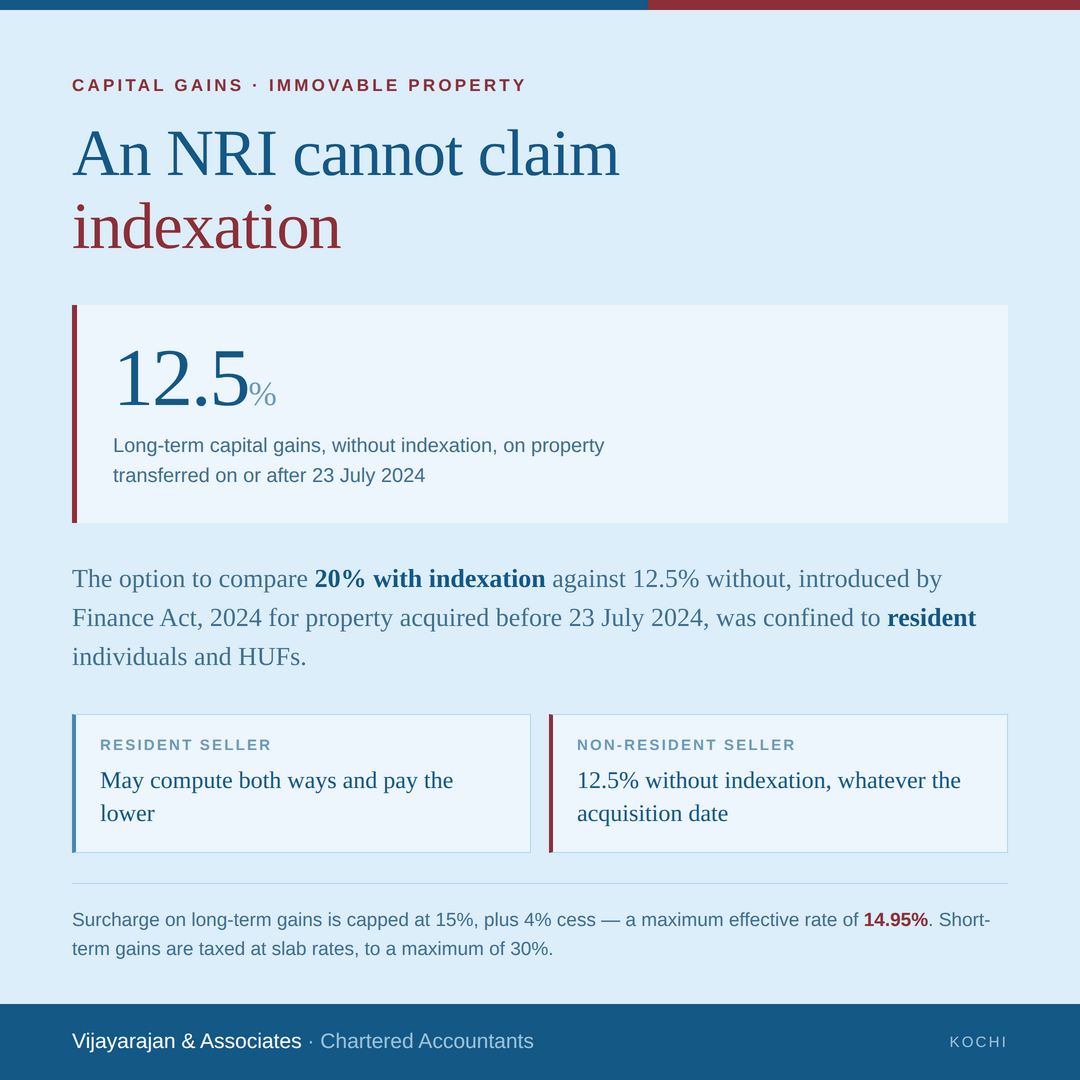
An NRI cannot claim indexation on immovable property transferred on or after 23 July 2024. This is the point most often got wrong, and getting it wrong understates the liability.
Finance Act, 2024 set the long-term capital gains rate on immovable property at 12.5 per cent without indexation. It also provided relief for property acquired before 23 July 2024, permitting a comparison between 12.5 per cent without indexation and 20 per cent with indexation, with the lower figure payable. That relief was confined to resident individuals and Hindu Undivided Families. Non-residents were not brought within it. For an NRI the rate is 12.5 per cent without indexation, whatever the date of acquisition.
The rate applies to the capital gain, not to the sale price, and the gain is still computed in the ordinary way. Cost of acquisition, cost of improvement and expenditure incurred wholly and exclusively in connection with the transfer remain deductible. Where the stamp duty value exceeds the stated consideration, the substitution provision may apply. Inherited and gifted property, co-ownership, and the reinvestment exemptions each carry their own rules. What indexation removes is the inflation adjustment to cost — not the cost itself.
The practical consequence for a long-held property is significant. A seller who acquired a Kochi flat in 2004 and sells in 2026 pays 12.5 per cent on a gain measured against the 2004 cost with no inflation adjustment across two decades. A resident owner of an identical flat may compute both ways and pay the lower amount.
Short-term capital gain is included in total income and taxed at the applicable slab rates, the highest of which is 30 per cent. There is no separate concessional rate for short-term gains on immovable property.
To either figure, add:
- Surcharge: 10 per cent where total income exceeds ₹50 lakh but not ₹1 crore, 15 per cent above ₹1 crore but not ₹2 crore, and 25 per cent above ₹2 crore under the default regime. Surcharge on long-term capital gains is capped at 15 per cent irrespective of total income.
- Health and Education Cess: 4 per cent on tax plus surcharge.
With the cap applied, the maximum effective long-term rate is 14.95 per cent (12.5 × 1.15 × 1.04).
Which provision governs the buyer's deduction?
Where the seller is a non-resident, the buyer's obligation arises under Section 393(2) of the Income Tax Act, 2025, and specifically under Table Sl. No. 17, which covers "any other sum chargeable under the provisions of this Act, not being income chargeable under the head Salaries" paid to a non-resident. The rate column for that entry reads "rates in force".
The resident-seller property provision is a different entry in a different table. Section 393(1) is an omnibus provision covering a range of payments to residents — rent, contractor and professional payments, interest, dividends, virtual digital assets and others. Transfer of immovable property appears there as Table Sl. No. 3(i), which prescribes 1 per cent of the consideration or the stamp duty value, whichever is higher, with a ₹50 lakh threshold. That is the successor to the old Section 194-IA, and it applies only where the transferor is a resident.
A buyer who deducts 1 per cent under Section 393(1) Sl. No. 3(i) because the asset is immovable property, without regard to the seller's residential status, has not discharged the obligation under Section 393(2). The consequences fall on the buyer: the buyer may be treated as an assessee in default for the shortfall, with interest. Where the payment is one that would otherwise be deductible in computing business income, disallowance can also follow — though that limb does not ordinarily bite on a private individual buying a residence, who does not claim the purchase price as a revenue deduction.
Because the entry specifies "rates in force" rather than a fixed figure, the withholding rate has to be worked out for the particular transaction. It depends on whether the gain is long-term or short-term, the Finance Act rate structure for the year, surcharge and cess, the documentation held, and any certificate obtained under Section 395. Applying a flat figure to every case without that determination is not a safe default in either direction.
Is tax deducted on the whole sale price or on the gain?
On the whole sale consideration. The buyer deducts on the entire amount payable to the non-resident seller, not on the capital gain.
This is the feature of the transaction that surprises sellers most, and it is worth stating without qualification. The buyer has no means of establishing the seller's cost of acquisition, improvement expenditure or exemption claims, and bears the consequences personally if the deduction falls short. The deduction is therefore made on the gross figure.
The scale is worth illustrating. Take a Kochi apartment acquired in 2012 for ₹45 lakh and sold in 2026 for ₹1.6 crore, with no further deductible cost. The long-term gain is ₹1.15 crore, and tax on that gain at 12.5 per cent plus 15 per cent surcharge plus cess is approximately ₹17.19 lakh. But the deduction is computed on the full ₹1.6 crore, which at the same effective rate is approximately ₹23.92 lakh — about ₹6.7 lakh more than the liability. The excess comes back only by filing a return and pursuing the refund, which on a non-resident return carrying a large refund claim is rarely quick.
The gap widens the longer the property has been held, because cost is a smaller fraction of price. On a property held since the 1990s it can be most of the tax.
The only way to bring the deduction down to something near the real liability is a certificate from the Assessing Officer, obtained before the payment is made. There are two routes to one.
How is the deduction brought down to the right figure? Two routes.
Section 395 provides two distinct applications, and practitioners should know which one fits the situation. Both are made to the Assessing Officer through the e-filing portal.
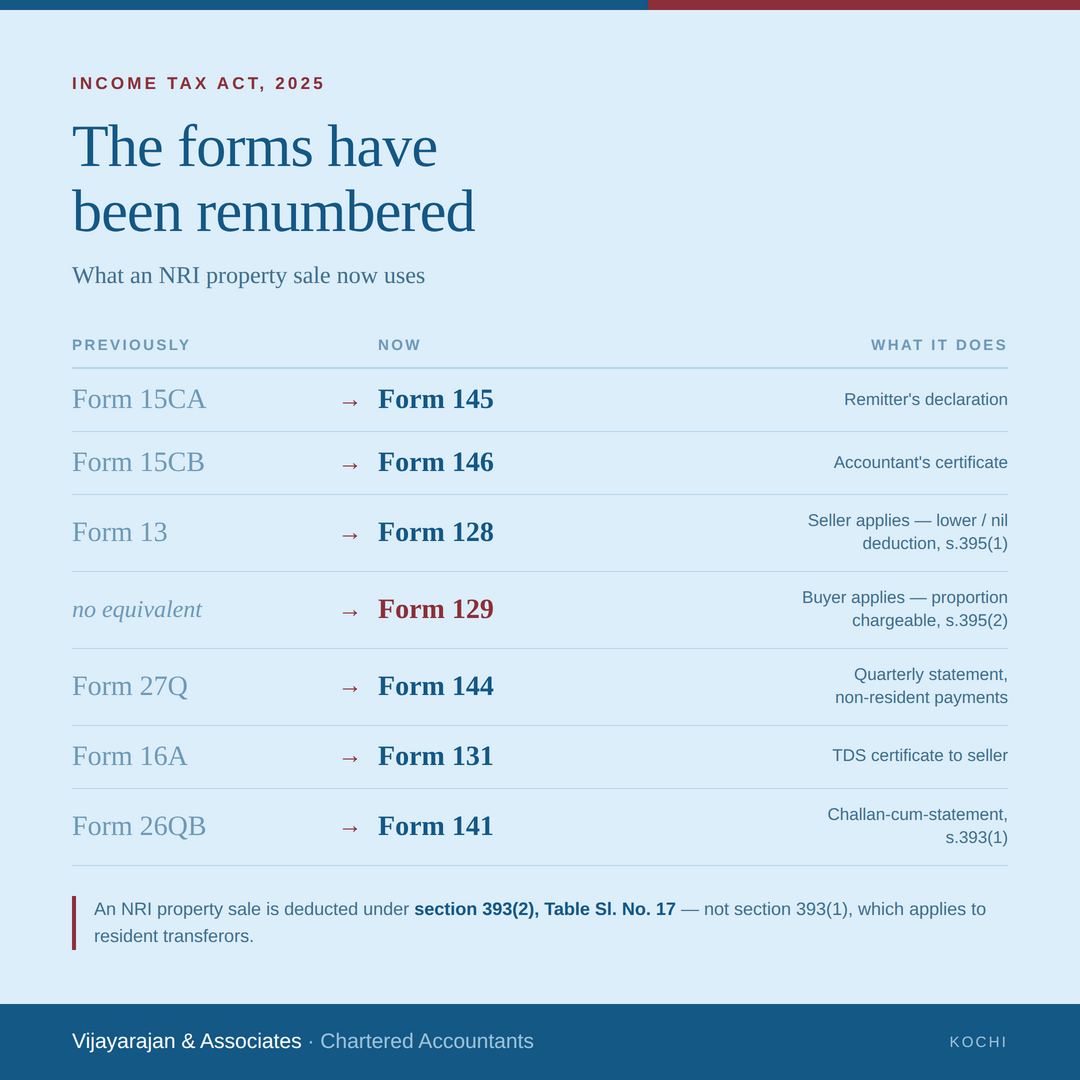
Route one — the seller applies. Under Section 395(1), the payee may apply for a certificate authorising deduction at a lower rate or no deduction, where total income justifies it. The application is made in Form 128 (Rule 213), the successor to Form 13.
Route two — the buyer applies. Under Section 395(2), the person responsible for paying a sum to a non-resident may apply for determination of the appropriate proportion of the payment chargeable to tax. The application is made in Form 129 (Rule 214). This route exists precisely for the gross-consideration problem: it is the buyer's own remedy, and it does not depend on the seller taking the initiative.
Either application should be supported by the computation of the estimated gain, the agreement or draft deed, proof of cost of acquisition and improvement (including the previous owner's documents for inherited property), and relevant bank records.
The Act prescribes no fixed period within which the Assessing Officer must dispose of the application. Processing time varies with jurisdiction and with any queries raised, so the application should be made well in advance and the timeline reflected in the agreement. Jurisdiction is with the income-tax authority having jurisdiction over the case; in non-resident matters this commonly falls within International Taxation administration, though allocation depends on PAN jurisdiction and prevailing faceless arrangements.
The certificate or determination must be in place before the payment or credit on which the parties intend to rely. A certificate obtained afterwards does not undo a deduction already made.
There is a second reason to take this step, which is easy to miss: an Assessing Officer's certificate under Section 395(1) or 395(2) also changes what is required at the remittance stage. See below.
Does the buyer need a TAN?
With effect from 1 October 2026, Section 397(1)(c) relieves a resident individual or HUF buyer of the requirement to obtain a TAN in respect of tax deductible on consideration paid to a non-resident seller of immovable property under Section 393(2), Table Sl. No. 17.
The relief is confined to resident individuals and HUFs. A company, firm or LLP buying from a non-resident continues to require a TAN.
What the relieved buyer uses instead needs care. The PAN-based challan-cum-statement in Form 141 is presently prescribed for specified deductions under Section 393(1) — that is, the resident-seller route — and it should not be assumed to extend automatically to a Section 393(2) deduction. Buyers and advisers should confirm the applicable challan-cum-statement and portal functionality against the CBDT notification and the e-filing portal as at the date of the transaction.
Where TAN remains required, the quarterly statement for deductions from payments to non-residents is Form 144 (previously Form 27Q). The certificate issued to the seller is Form 131 (previously Form 16A), prescribed by Rule 215 for deductions including those under Section 393(2) and issued under Section 395(4).
Remitting the proceeds: Form 145 and Form 146
Rule 220 of the Income-tax Rules, 2026 replaced Rule 37BB. The two familiar forms are renumbered — Form 145 for the remitter's declaration (previously Form 15CA) and Form 146 for the accountant's certificate (previously Form 15CB) — but the more important change for planning purposes is that Form 145 now has four parts, and which part applies decides whether an accountant's certificate is needed at all.
- Part A — the remittance is taxable and the aggregate of such remittances does not exceed ₹5 lakh in the tax year. No certificate required.
- Part B — the remittance is taxable, exceeds ₹5 lakh, and a certificate under Section 395(1) or 395(2) has been obtained from the Assessing Officer. Form 146 is not required.
- Part C — the remittance is taxable, exceeds ₹5 lakh, and a certificate in Form 146 from an accountant has been obtained.
- Part D — the remittance is not chargeable to tax, other than payments referred to in Rule 220(3).
The planning point follows directly. A seller who has already obtained a Section 395 certificate to reduce withholding proceeds under Part B and does not need a separate Form 146 at the remittance stage. The same application therefore does double work. Advising a client to obtain the certificate and then also commission Form 146 imposes a cost the Rules do not require.
Where a bank still asks for "15CB", it is asking for Form 146 by its former name. Confirm the position with the authorised dealer before initiating the remittance rather than at the counter.
Does a tax treaty help?
For most NRI sellers, no — and it is worth being plain about why, because clients often expect otherwise.
Gains from immovable property situated in India are taxable in India under the capital gains article of India's treaties. Unlike dividends, interest and royalties, where treaties cap the Indian rate, there is no treaty ceiling on gains from Indian immovable property. For a seller resident in the UAE, Saudi Arabia, Qatar, Kuwait, Oman or Bahrain — none of which levies a personal capital gains tax — that is the end of the enquiry. India taxes, the country of residence does not, there is no double taxation to relieve, and no treaty claim arises on the gain. A Tax Residency Certificate serves no purpose for this transaction.
The position is different where the seller is resident in a country that taxes its residents on worldwide capital gains, such as the United States, the United Kingdom, Germany, Sweden, Canada or Australia. The situs rule permits India to tax the gain; it does not remove the residence country's right to tax the same gain. Relief is given in the residence country, ordinarily by credit for the Indian tax, and the foreign return will need the Indian computation and evidence of payment. For the growing number of Kerala families settled outside the Gulf, this should be identified before completion rather than at the foreign filing deadline, because the credit usually depends on the timing and characterisation of the Indian tax.
Checklist
For the seller
- Establish residential status for the relevant tax year under both the Income Tax Act and FEMA, on the facts, before the agreement is finalised.
- Compute the capital gain properly — cost of acquisition and improvement, transfer expenditure, stamp duty value substitution where applicable, inherited-property and co-ownership rules, and any reinvestment exemption. Apply the 12.5 per cent rate to the resulting long-term gain. Do not model an indexation comparison; it is not available to a non-resident.
- Consider an application under Section 395(1) in Form 128 well before the expected date of payment, and note that the resulting certificate also permits Form 145 Part B at the remittance stage.
- If resident in a country that taxes worldwide capital gains, plan the credit claim in that country before completion. Gulf-resident sellers have no treaty claim to make on the gain and do not need a Tax Residency Certificate for this purpose.
- File the Indian return for the year of sale to recover the excess deduction — on a gross-consideration deduction there will almost always be one.
- At remittance, identify which Part of Form 145 applies before commissioning Form 146.
For the buyer
- Establish the seller's residential status on documentary evidence, not assertion.
- Deduct under Section 393(2), Table Sl. No. 17. Section 393(1), Table Sl. No. 3(i) applies to resident transferors and is not available merely because the asset is immovable property.
- Determine the rate in force for the transaction rather than applying a flat figure.
- Where the whole payment is not chargeable, consider your own application under Section 395(2) in Form 129 instead of waiting on the seller.
- From 1 October 2026, a resident individual or HUF buyer is relieved of TAN under Section 397(1)(c); confirm the applicable challan-cum-statement and portal functionality for a Section 393(2) deduction before relying on it. Companies, firms and LLPs still require a TAN and file Form 144.
- Issue the certificate in Form 131 to the seller.
The FEMA side of the transaction — permissible remittance limits, property acquired by inheritance or gift, and the position where sale proceeds exceed the original foreign-currency investment — is dealt with separately in [FEMA and repatriation of property sale proceeds by an NRI].
Frequently asked questions
Which section applies to TDS when buying property from an NRI? Section 393(2) of the Income Tax Act, 2025, specifically Table Sl. No. 17. Section 393(1), Table Sl. No. 3(i) — the 1 per cent deduction — applies only where the transferor is a resident.
Is TDS deducted on the sale price or on the capital gain? On the whole sale consideration. The buyer has no means of establishing the seller's cost and bears the risk of shortfall personally. A certificate under section 395 is the only way to reduce it.
Can an NRI use the 20 per cent with indexation option? No. The comparison introduced by Finance Act, 2024 for property acquired before 23 July 2024 was confined to resident individuals and Hindu Undivided Families. For a non-resident the rate is 12.5 per cent without indexation, whatever the acquisition date.
What replaced Form 13 for a lower deduction certificate? Form 128, made under section 395(1) by the seller. Separately, the buyer may apply in Form 129 under section 395(2) for determination of the proportion of the payment chargeable to tax.
Does the buyer need a TAN to buy property from an NRI? From 1 October 2026, a resident individual or HUF buyer is relieved of the TAN requirement by section 397(1)(c). Companies, firms and LLPs still require one and file Form 144.
What replaced Forms 15CA and 15CB? Form 145 and Form 146 respectively, under Rule 220 of the Income-tax Rules, 2026. Form 146 is not required where a certificate under section 395(1) or 395(2) has been obtained — that remittance goes under Part B of Form 145.
Is the holding period for long-term gains on property 24 months or 36 months? 24 months for immovable property. Where property has been inherited, the previous owner's holding period is included.
Does a tax treaty reduce the Indian tax on the gain? No. Gains on immovable property situated in India are taxable in India and no treaty caps the rate. For sellers resident in the Gulf, where there is no local capital gains tax, that ends the matter. For sellers resident in countries that tax worldwide gains, the treaty governs relief by credit in that country.
About the writer
CA Vijay Krishnan is Managing Partner of Vijayarajan & Associates, Chartered Accountants, Kochi (ICAI Firm Registration No. 006272S, in practice since 1993). He holds B.Tech, LL.B, FCA and DISA qualifications and works principally in NRI and cross-border taxation, FEMA, and statutory audit.
Disclaimer
The views expressed in this article are those of the writer. They represent one reading of the law as it stands in September 2026, set out for general information and discussion. Nothing in this article is a professional opinion, advice, or a certificate of any kind, and it should not be relied upon as such. No person should act, or refrain from acting, on the basis of this article alone.
The Income Tax Act, 2025 and the Income-tax Rules, 2026 are of recent application, and the position on several matters discussed here — including form prescriptions, administrative practice and portal functionality — continues to develop through notifications, circulars and departmental clarifications. The provisions referred to should be verified as they stand on the date of the transaction concerned.
Every transaction of this kind turns on its own facts. Appropriate professional advice should be obtained on the specific facts before any position is adopted or acted upon.

CA Vijay Krishnan B.Tech; LL.B; FCA;DISA(ICAI)
Managing Partner, Vijayarajan & Associates. FCA, DISA, LL.B, B.Tech. NRI and cross-border taxation, FEMA, statutory audit.
No comments yet. Login to start a new discussion Start a new discussion